
Topic · Kitchen Equipment Basics
Butchering Knives
When it comes to knives for butchering meat, poultry, and fish, you’ll notice a big difference between Western and Japanese knives. Western butchering knives tend to be thinner, narrower, and more flexible than their Japanese counterparts.

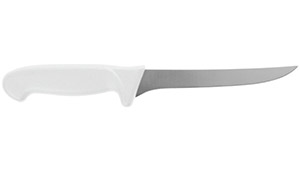
Boning knives are meant for cutting around bones and between joints. They are usually between 5 and 6 inches (13 and 15 cm), which is on the longer side, and somewhat flexible. This blade is narrow and thin for excellent tip control while doing delicate work under silver skin and between muscles.
I recommend boning knives for meat and poultry, but for fish, Western chefs usually use an even longer and more flexible knife, the fillet knife. This knife is designed to cut as close to the bone as possible.
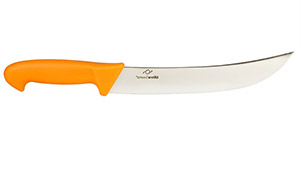
When it comes to cutting large pieces of raw meat, you’ll want to use a scimitar knife. It is curved like the Middle Eastern sword of the same name, and typically 12 inches (30 cm) or longer.
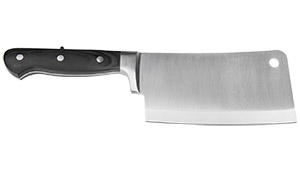
The meat cleaver is great for chopping through bones and tendons. It’s large, heavy, and rectangular, and has a convex edge. The side of the meat cleaver can be used for crushing ingredients like garlic.
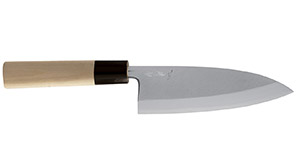
The Deba is an extremely sharp Japanese knife used for butchering boneless meat and filleting fish. Its thick, stiff, single-beveled blade lets you cut very close to the bone and to cleanly remove the fillet in fewer strokes.
Kodeba translates to “small Deba” and is used for smaller fish.
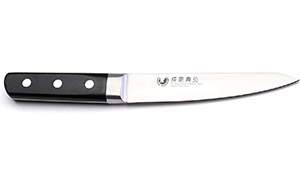
For bone-in meat, Japanese chefs use a Hankotsu, a short, stiff, and narrow knife.
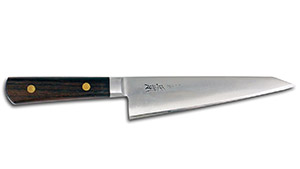
A Garasuki, which was developed in Japanese restaurants specializing in poultry, is a wider knife used for separating poultry meat and cutting through bone. This knife does not have a Western equivalent.
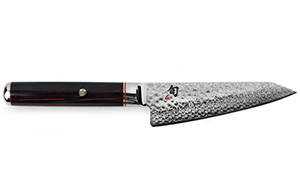
The all-purpose knife Honesuki is narrower than the Garawuki and wider than the Hankotsu. It is used for boning meat and poultry.
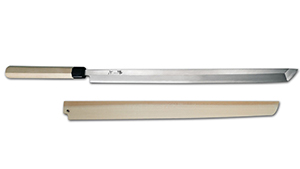
The Maguro is the largest, most impressive-looking butchering knife that Japan has to offer. In fact, it looks more like a sword! You can see these in action at the Tsukiji Fish Market in Tokyo, where they are used for their intended purpose of cutting up large tuna.