
Topic · Kitchen Equipment Basics
Blade Styles
There is a variety of blade styles, and they range depending on the shape, types of edge, and geometry. Below, you will find everything you need to know blades.

Edge Shapes
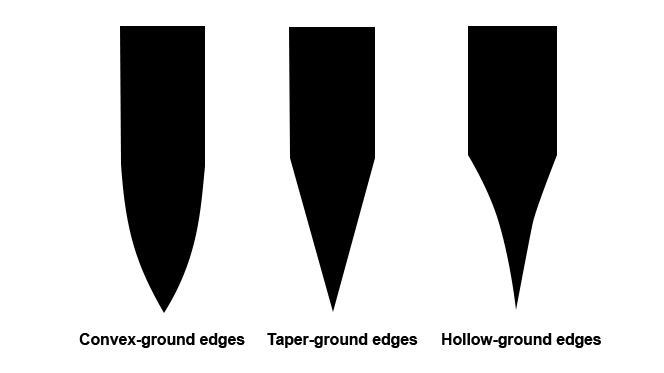
There are three possible edge shapes: taper-ground, convex-ground, and hollow ground. Each of them serves a different purpose and is found in different kinds of knives, as follows:
- Taper-ground edges: these are the most common ones. The distinctive V-shaped blade results from the fact that the blade tapers from the spine to the edge. They are sturdy edges and are commonly used in all-purpose knives, such as chef’s knives, paring knives, and utility knives. Distal tapering is when the blades taper from the heel of the knife to the tip.
- Convex-ground edges: unlike the taper-ground edge, this one creates a broader area directly behind the edge because of the sides of the blade arc near the edge. Similarly to the taper-ground edge, these are sturdy too, and they are suitable for chopping through bone and similar heavy tasks.
- Hollow-ground edges: in this case, the grinding process begins at a lower point, usually a quarter to halfway down on the blade, resulting in a concave slope at the edge. This makes the edge very sharp in many cases. Such edges are found on slicing knives and on inexpensive ones.
Types of Edge
There is a variety of edge types out there, and each one serves a different purpose, as indicated below:
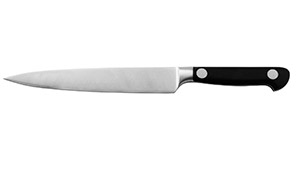
Fine edges: these are straight and uninterrupted from heel to point. They are easy to sharpen and make clean cuts.
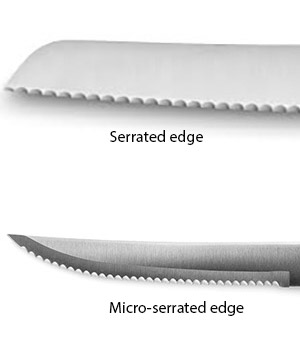
Serrated and micro-serrated edges: these have saw-like teeth running along with them. They are mostly found on bread and tomato knives. The advantage they offer is that they need sharpening less often since they hardly ever come in contact with the board. When they do, however, they need to be sharpened using special tools, so taking them to a professional might be inevitable. Otherwise, you can replace the knife when it gets dull, generally after 10 or 15 years, depending on the frequency of usage.
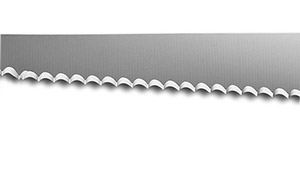
Scalloped edges: these are the exact opposite of serrated edges, in the sense that the arches bend outward from the blade. Properties and uses are similar to serrated-edged knives, but scalloped edges are less resilient to wear.
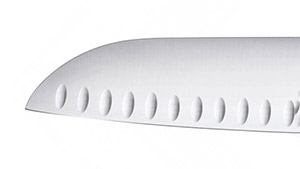
Granton edges: they feature hollows, called “grantons,” ground on the side of the blade so that air pockets are created between the blade and the food and prevent it from sticking on the sides of the blade. They are most commonly found on knives used to slice meat or fish, while more recently, they have been added to chef’s knives and Santokus.
Symmetric and Asymmetric Edges
At this point, special mention should be made of the distinction between Western and Japanese knives. Since in Japan, much of the food is consumed raw, Japanese knives are the sharpest ones on the market since this helps the structural integrity of the food remain as close to its original state as possible. The sharpness of the blade also helps cause less damage to the cells that hold the ingredients together and slows down the cell degradation that begins when the food is cut.
Having said that, it is important to explain that sharper edges are achieved by decreasing the angle of the edge. Western knives and Western-style Japanese knives are symmetrically double-beveled. In other words, the angle of slope is the same on both sides of the knife. This angle is typically between 20 and 30 degrees on each side in Western knives. In Western-style Japanese knives, however, this angle is reduced to 10 to 20 degrees per side.
On the other hand, Japanese knives are traditionally asymmetrically single-beveled, which means that one side is either flat or slightly concave, while the other has a beveled edge of between 10 and 20 degrees that slopes down from the side of the blade. Such knives are typically used for sashimi and similar preparations. There are also asymmetrically double-beveled knives, featuring different size bevels on either side of the blade, with the rations being 70:30 or 90:10.
Note: Although there are knives for both right-handed and left-handed people, the latter is more expensive, since they are used by only 10% of the population. Therefore, many apprentice chefs learn to use their right hand when cutting until they can afford left-handed knives.