
Topic · Kitchen Equipment Basics
Bakeware Pan Sizes
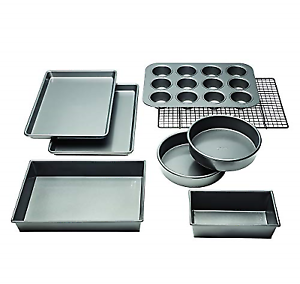
When you are preparing to create a recipe that requires the use of bakeware, you should first determine whether you have the proper sized pan. There are many different types of bakeware, such as round pans, square pans, rectangle pans, tube pans, bundt pans, jelly roll pans, loaf pans, springform pans, roasting pans, and casseroles. Your recipe will suggest that you use a certain size and type of pan. If you do not have the pan that is requested, you can generally substitute a similar size pan without any problem.
The information below will help you make the appropriate substitution:
Select a pan that is as close to the same size as the pan indicated in the recipe. The pan should have approximately the same volume capacity and when filled, the ingredients should be close to the same depth as they would be in the original sized pan. To find the surface of a pan uses the equations below: (Click the + sign to access the formula.)
Formula
Width x Length = Total Square Inches
Ex: 9″ x 13″ = 117 Square Inches
Formula
- Step 1. Diameter ÷ 2 = Radius
Ex: 9″ ÷ 2 = 4.5″ - Step 2. Radius x Radius x (3.14)
Ex: 4.5″ x 4.5″ x 3.14 = 64 Square Inches
- If the pan is close in size and volume to the original, the cooking temperatures and times should not have to be adjusted
- When measuring a pan, measure from the inside edge to inside edge so that you are not including the thickness of the sides in your measurement. Measure the depth by placing the ruler inside the pan and measuring from the bottom up to within a ¼ inch of the top edge. If the pan has slanted sides, be sure to keep the ruler straight and do not slant when measuring
- Measure volume by filling the pan with water and then pouring the water into a measuring cup to measure how much water is in the pan or you can also measure the water as you pour it into the pan
- Be careful substituting a pan when the recipe indicates that a tube pan should be used, such as an angel food cake pan or a bundt pan. Generally, the recipe requires this type of pan so the heat is distributed properly. This is necessary for the food to get to its proper doneness
- If you select a glass bakeware dish or a dark, non-stick pan, reduce the oven temperature by 25°F
- If selecting a pan that results in the depth of the ingredients to be thinner, reduce the cooking time by 10 to 15 minutes. If the depth of the ingredients is thicker, increase the cooking time by 10 to 15 minutes. Be sure to use the visual indicators to test for the proper doneness
- If a casserole dish has to be substituted for a different size when making a savory dish, use the same guidelines as baked goods. Use a dish that holds close to the same volume and if you substitute one that will affect the depth of the ingredients, adjust the cooking times to use less time for thinner depths and more time for thicker depths
The chart below shows the sizes and volume of some of the common bakeware pans. The chart will help to assist you in selecting a successful substitution. Click the link to open the PDF. Bakeware Pan Sizes and Volume
Keep in mind, when selecting a substitution according to the pan’s volume, that you need to allow room for expansion of certain foods as they cook. Certain types of food need more room for expansion than others. Fill the pan as directed by the instructions on the recipe. If you select a pan that has a comparable volume to the original size suggested by the recipe, it should allow the necessary room for expansion.