
Topic · Food Handler Certificate
Should I use antibacterial soap or regular hand soap?
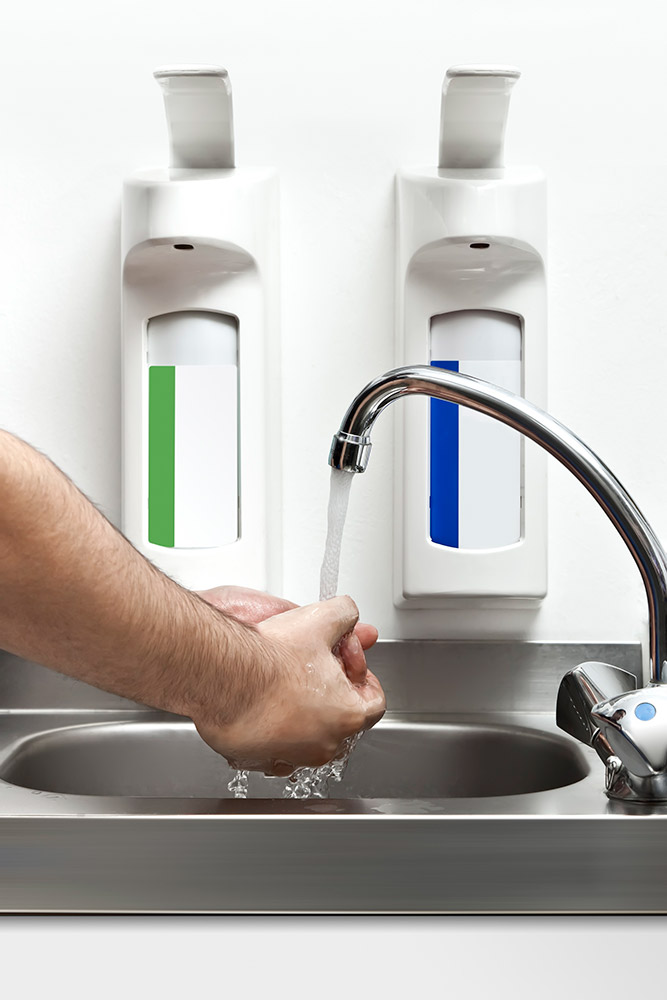
Antibacterial soap is any cleaning product with added active antibacterial ingredients. These chemicals kill bacteria and microbes. Many, or even most, liquid hand and body soaps contain antibacterial chemicals. Triclosan is a common ingredient, as is alcohol. Since there is a great variety of bacteria, effectiveness against any given type of bacterium does not ensure that it is effective against unrelated types. This is why most ads claim to “kill 99% of bacteria and germs”, but this 1% left is what we should be worried about! (See Lesson 2 “Spores and Toxins”)
Good question! But before answering it, let’s have a look at their composition:
These agents are generally only contained at a preservative level unless the product is marked antibacterial, antiseptic, germicidal, or deodorant. Triclosan, Triclocarban, Trichlorocarbamide, and PCMX Chloroxylenol are commonly used for antibacterial and deodorant purposes in consumer products.
Some soap contains tetrasodium, which is a chelating agent that sequesters metals that the bacteria require to grow. Other microbes also need metals, and so it is an antimicrobial agent that is widely used even as a preservative. It appears to be relatively harmless in the environment.
Regular hand soap is a cleaning agent, manufactured in bars, granules, flakes, or liquid form, made from a mixture of the sodium salts of various fatty acids or natural oils and fats. Soap is a combination of animal fat or plant oil and caustic soda. When dissolved in water, it breaks dirt away from surfaces. Through the ages, soap has been used to cleanse, to cure skin sores, to dye hair, and as a salve or skin ointment. But today we generally use soap as a cleanser or perfume.
The exact origins of soap are unknown, though Roman sources claim it dates back to at least 600 B.C. when Phoenicians prepared it from goat’s tallow and wood ash. Soap was also made by the Celts, ancient inhabitants of Britain. Soap was used widely throughout the Roman empire, primarily as a medicine. Mention of soap as a cleanser does not appear until the second century A.D. By the eighth century, soap was standard in France, Italy, and Spain, but it was rarely used in the rest of Europe. Its usage was generalized throughout Europe by the end of the 17th century and during cooking, primarily when you handle meat and seafood products. By doing so, you will partially control and reduce the risk of foodborne illnesses. But do not stop there. Wash your hands also after taking the bus, using the washroom, using your computer, etc. This will highly reduce the risk for you to carry and spread viruses, and it will help you to stay healthy.
Overuse
Overuse of chemicals like triclosan has been suggested to cause sensitive bacteria to evolve resistance to its antibacterial action. Should any antibiotic be discovered that works similarly to triclosan, this antibiotic’s effectiveness to combat infections will be reduced because people will be hosting resistant bacteria already due to their use of soaps containing triclosan?
Research
Studies have examined the purported benefits of antibacterial soap. Some studies have concluded that merely washing thoroughly with plain soap is sufficient to reduce bacteria and further, is effective against viruses. Other studies have found that soaps containing antimicrobial active ingredients remove more bacteria than simply washing with plain soap and water (J.C. Lucet (2002), Hand Contamination Before and After Different Hand Hygiene Techniques: a Randomized Clinical Trial, Journal of Hospital Infection; L.L. Gibson (2002), Quantitative Assessment of Risk Reduction From Hand Washing with Antibacterial Soap, Journal of Applied Microbiology). The U.S. Food and Drug Administration published a report that questions the use of antibacterial soap and hand sanitizers, saying that it found no medical studies that showed a link between a specific consumer antibacterial product and a decline in infection rates.
At one conference, Dr. Stuart Levy, a microbiologist at Tufts University, cites these studies to conclude: “Dousing everything we touch with antibacterial soaps and taking antibiotic medications at the first sign of a cold can upset the natural balance of microorganisms in and around us, leaving behind only the ‘superbugs'”.
Bottom line
You must wash your hands often, including before and during cooking, especially when you handle meat and seafood products. By doing so, you will partially control and reduce the risk of foodborne illnesses. But do not stop there. Wash your hands also after taking the bus, using the washroom, using your computer, etc. This will highly reduce the risk for you to carry and spread viruses, and it will help you to stay healthy.
