Topic · Cook-Along: Salads & Side Dishes
Knife Cuts for Salads
A salad is only as good as its cuts. Neat, even pieces look professional, but they also taste better: they dress evenly, give the right bite in every mouthful and keep their texture. Most salad cuts are simple. Here are the ones you will use most, with the videos that show them step by step.
Before you start
- Use a sharp chef’s knife; a dull knife crushes vegetables and slips. See How to Hone a Knife with a Steel.
- Put a damp towel under your cutting board so it does not move.
- Hold the knife with a pinch grip and protect your guide hand with the “claw”: fingertips tucked, knuckles against the blade.
- Square off round vegetables (cut a flat side) so they sit flat on the board.
- Use a board kept for vegetables and ready-to-eat foods, never one used for raw meat.
Slicing (émincer)
Thin, even slices of the same thickness: cucumbers, radishes, mushrooms, fennel, red onion. Glide the knife forward and down in one smooth movement rather than pressing straight down. For very thin slices of cucumber, radish or fennel, a mandoline is faster (always use the hand guard).
Chiffonade
Fine ribbons of leafy herbs or greens: basil, mint, sorrel, spinach, romaine, radicchio. Stack the leaves, roll them tightly like a cigar, then slice across the roll as finely as you can with a sharp knife. Cut basil and mint at the last minute; they darken quickly. See Chiffonade in the glossary.
Julienne (matchsticks)
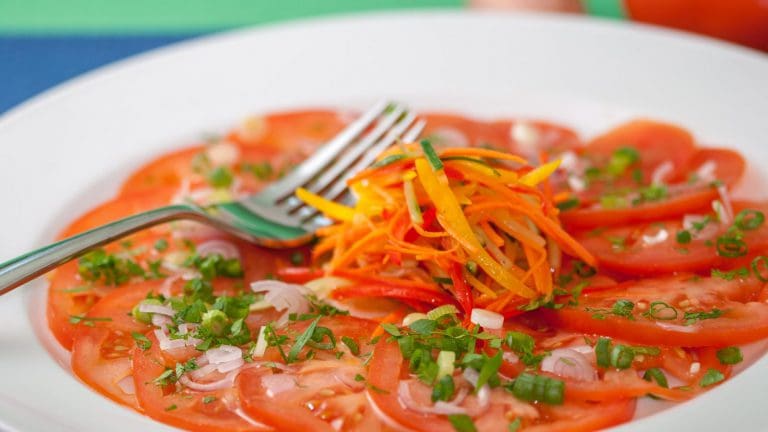
Thin sticks about 5 cm (2 in) long and 2 mm (⅛ in) square: carrots, celery root, cucumber, bell peppers, apple, jicama. Cut thin slices, stack them, then cut the stack into thin sticks. Julienne is used for celery rémoulade, slaws and the garnish of many composed salads.
Practise with the Tomato Vegetable Julienne Salad:
Brunoise (fine dice)
Tiny cubes of about 2 to 3 mm (⅛ in), made by cutting a julienne crosswise. Brunoise of shallot, red pepper, cucumber or carrot is used to garnish salads and to add colour and texture to vinaigrettes. See Brunoise.
Dice
Even cubes for potato, beet, cucumber, tomato and grain salads: small dice 6 mm (¼ in), medium 1 cm (½ in). Even pieces cook evenly and look neat in salads such as the Russian Salad.
Mincing shallots and chopping herbs
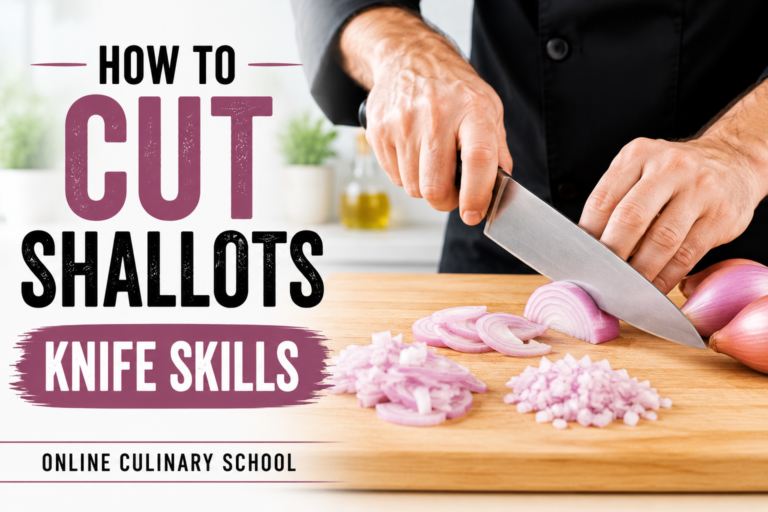
Finely minced shallot is in almost every French vinaigrette, and fresh herbs finish most salads. Chop herbs with a sharp knife, not a dull one that bruises them, and only just before using.
Tomatoes: core, julienne and dice
Cabbage for slaws
Quarter the cabbage, cut out the hard core, then slice each quarter across as thinly as possible, or shave it on a mandoline.
Citrus segments (suprêmes)
Segments of orange or grapefruit without any skin, pith or membrane, for fruit salads and salads such as beet and orange. Cut off the top and bottom, slice away the peel and all the white pith following the curve of the fruit, then cut between the membranes to release each segment. Work over a bowl and squeeze the leftover membranes to collect the juice for your dressing.
Shaving and ribbons
- Ribbons: use a vegetable peeler to cut long ribbons of carrot, zucchini, cucumber or asparagus for raw salads.
- Shavings: a peeler also makes beautiful shavings of Parmesan or aged cheese.
- Spiralizer: for zucchini, beet or carrot “noodles”.
Practise
- Grated Carrot Salad (grating)
- Celery Rémoulade (julienne)
- Classic Creamy Coleslaw (shredding)
- Beet and Orange Salad (dice and citrus segments)
Key terms in the glossary: Julienne, Brunoise, Chiffonade, Citrus Suprême, Mandoline.
Chef Eric’s tip: cut everything for a salad to roughly the same size, so that each forkful holds a little of every ingredient. That is what makes a salad taste “together”.