Topic · Vegetable Cookery Fundamentals
Cutting Celery
Mirepoix is a mix of aromatic vegetables that is common in French cuisine. The classic ingredients are a 2-1-1 medley of diced onion, carrot, and celery. If the mirepoix will be part of the final dish, it is important to chop the vegetables evenly. However, if it will be strained out (in the case of stock) nothing more than a quick, rough chop is required.
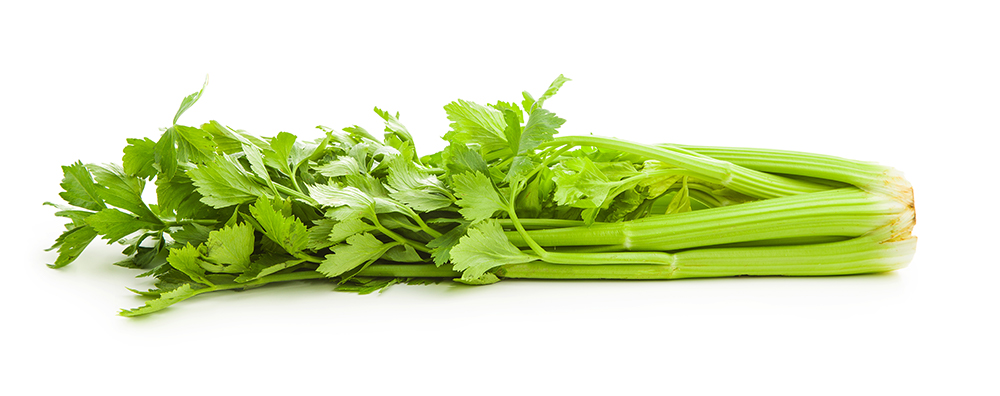
Celery is also common in stir-fries, braises, soups, and salads, so it’s a good idea to know how to do a few attractive cuts. I’ll give you some suggestions.
For some recipes, you’ll need to remove the fibrous celery strings on the outside of the stalk. Just scrape the celery with the spine of your knife—they’ll come right off.
Cutting Batonnets
For cutting batonnets, you have to deal with both the wide, flat root end and the top end that branches into several thin pieces. This can present a challenge, especially since the stalk is also shaped like an arch. To solve this, cut each stalk into three sticks. I recommend using a Chef’s knife or a Santoku.
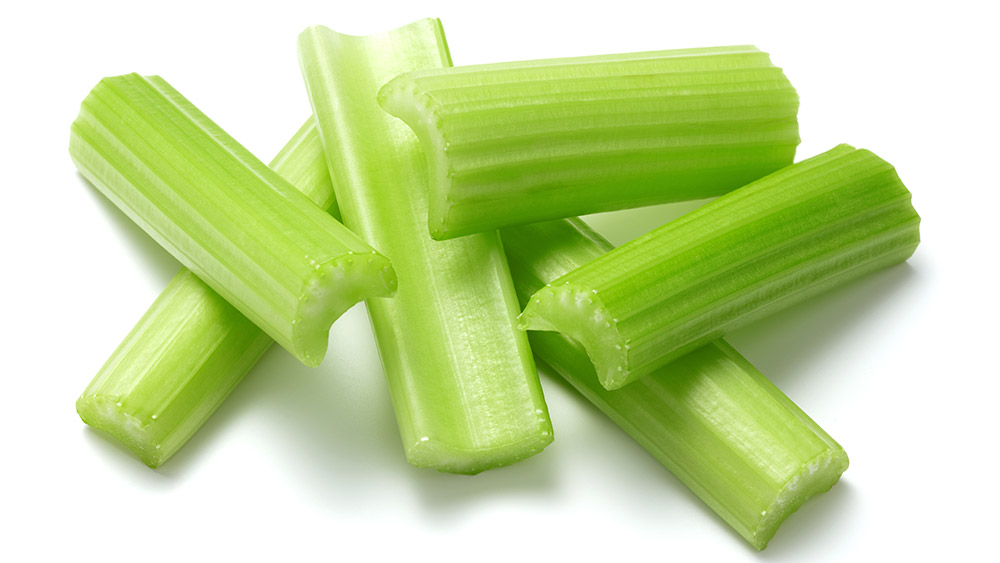
- Set the celery stalk on the cutting board, hollow side down. The root end should face your knife-hand. With your knife hand in the claw position, cut off the bottom, white end of the celery, and set it aside for stock.
- Shift your guide fingers back to cut off a 2 ½ inch (6 cm) piece of stalk.
- Continue this to cut the stalk into equal pieces, up to the point where the stalk branches. Conserve the top part.
- Place a piece of stalk parallel to the knife and so that one edge lays flat against the board (as opposed to sitting on the arch). Remove ⅓ of the piece by making a lengthwise cut.
- With the remaining piece, set it flat against the board and use your guide hand in the claw position to anchor it. Cut it in half along its length.
The result is three pieces of the same size. Though they lack the squared ends of a traditional batonnet cut, they perform the same function.
- Repeat steps 4 and 5 for each of the remaining 2 ½ inches (6 cm) lengths of celery.
- Remove the leaves from the top section of the celery by pulling or cutting.
- Stand the top section on its end with your guide hand and cut the small branches from the main stalk. The removed pieces should be set aside for stock.
- Cut the main stalk of the top section in half lengthwise.
Cutting Celery Small Dices
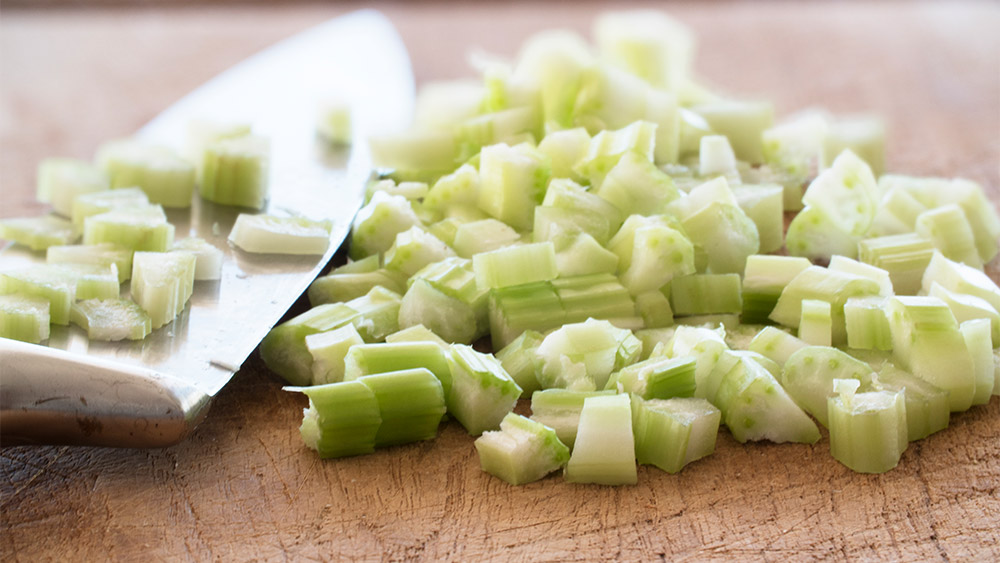
Since you already know how to cut batonnets, you’re just a tiny step away from cutting small dice. I recommend practicing your batonnets for a while until you get comfortable cutting several at once, which you’ll need to be able to do for cutting small dice.
- Line up several batonnets and use your guide hand to steady.
- Place the blade against your fingers so that the distance from the edge of the celery to the knife is equal to the width of the batonnets. Cutting down creates a set of dice.
- Shift your fingers and the blade back to cut another set of dice.
- Repeat step 3 for all the batonnets.
Cutting Celery Flakes
This wing-shaped cut looks great in stir-fries and other dishes. The stalk you use should be trimmed on the top and bottom so as to look more attractive. The angle of the knife affects the look of this cut, but there is no right or wrong angle; it’s all about preference.
I’ll show you two different ways to cut flakes, and you can decide which one you like better.
Technique 1
- Place the stalk on the board arch side down, with your guide hand steadying in the claw position.
- About ¾ inch (2 cm) in from the knife-hand side, place your blade on the stalk at a 45-degree angle. The spine should be pressed against your guide fingers. Cut through the stalk at that angle, and discard the resulting piece.
- Without moving the spine of the knife away from your fingers, move it ⅛ inch (3 mm) and cut another flake at the 45-degree angle.
- Repeat step 3 for the rest of the stalk, discarding the end piece.
Technique 2
- Place the stalk on the board arch side down. With your guide hand, lift the celery stalk to a 45-degree angle.
- About ¾ inch (2 cm) in from the knife-hand side, place your blade perpendicularly on the stalk. Cut straight down and discard the resulting piece.
Note: With this technique, the stalk’s weight rests on the “pillars” of the arch that is touching the board. Each cut removes the weight-bearing piece, and the stalk drops onto new “pillars.” While most cutting techniques have you moving the knife across the food, in this case, the guiding hand moves the food into the path of the knife.
- About ⅛ inch (3 mm) in from the knife-hand side, make a cut straight down to create the first useable flake.
- With every piece you cut, you will need to make sure that the blade is placed ⅛ inch (3 mm) in from the knife-hand side in order to create even flakes. Repeat step 3 for the whole stalk, discarding the final piece.
Cutting Celery Paysannes
For this most common celery cut, I recommend using a Chef’s knife or Santoku. You will need a stalk with the top and bottom trimmed off. You can choose how large or small to make the paysanne pieces depending on the purpose that you have in mind.
- Place the stalk on the board arch side down, with your guide hand steadying in the claw position.
- With the blade against your guide fingers, cut down to create a paysanne.
- Shift your blade and fingers black slightly, then cut down for another paysanne.
- Repeat step 3 for the rest of the stalk.