Topic · Vegetable Cookery Fundamentals
Cleaning Leeks
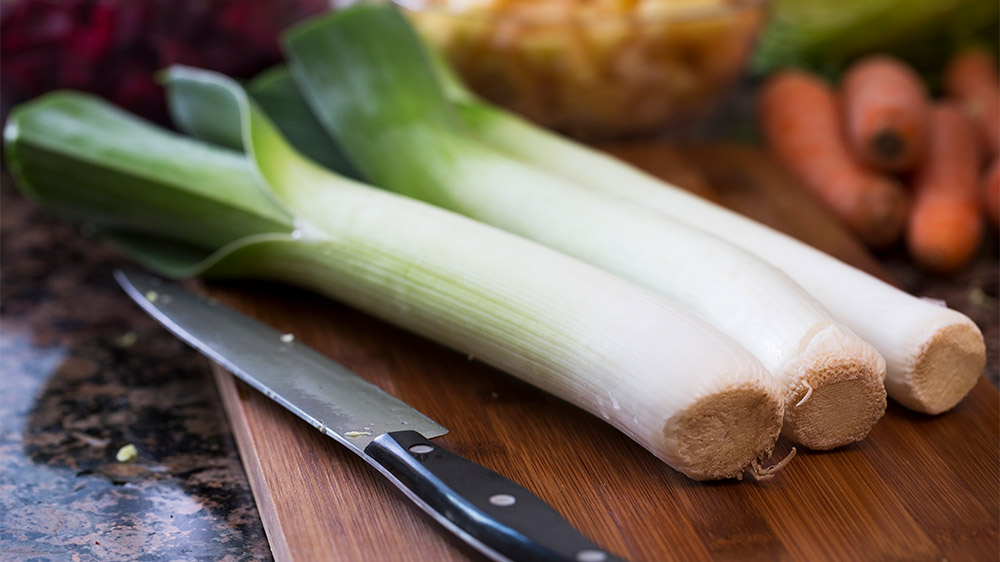
To trim, clean and slice or chop leeks: With a chef’s knife, remove the leaf ends or whole leaves. Trim off the roots. Starting 1 inch from the root end split the leek lengthwise in four. Fill a basin or sink with cold water and swish the leeks in the water. Repeat if necessary to remove all the dirt. Cut crosswise to slice. Chop into smaller pieces if desired. Safety: Position of the finger of the hand which is holding the leek is very important. Watch your thumb!
What is a leek?
Leeks are sweet, moderately flavored members of the onion family. They are long and cylindrical with a pale white root end and dark green leaves.
Which part should I use?
Leeks come with one part green and the other part white. The green part is exposed to the sun and is full of chlorophyll. When a recipe calls for a leek without any other specification, you should use the whole leek, if the recipe calls for the white or the green part, then you should use only the referred part.
The leek, Allium porrum, is a member of the onion family, but the flavor is much more refined, subtle and sweet than the standard onion. Thought to be native to the Mediterranean area and Asia, leeks have been cultivated for more than 3,000 years and have long been popular in Europe. After the children of Israel left Egypt, leeks were one of the foods mentioned in the Book of Numbers in the Bible as being greatly missed.
In France, the leek is known as Poireau, which interestingly enough is also a derogatory term meaning “simpleton”. European chefs call leeks “poor man’s asparagus.” Asparagus is actually a distant relative of the leek, related to the same Lily family as onions. Although giant leeks do not lend much taste when eaten, Britain holds a yearly competition and awards a prize to the largest leek, which can range from 4 to 5 inches in diameter.
Wild leeks, also called ramps, are of a different variety. They are much smaller, more akin to small scallions or young shallots. Unlike the leek, they have a very strong aroma and flavor.
Leeks have long been treasured in Europe and the Mediterranean. Americans have just recently joined on the leek bandwagon. Soups have popularized the use of leeks. But new food combinations are bringing the leek more into the gourmet limelight. Leeks are readily available all year round in most markets these days, so if you haven’t yet tried cooking them at home, it’s time you enjoyed their subtle, sweet flavor.