Topic · Vegetable Cookery Fundamentals
Avocado Techniques
There are many varieties of avocados, but you are probably most familiar with the Hass avocado. This avocado has a bumpy peel that is dark green to almost black, depending on ripeness. Preparing an avocado is unique because, unlike most fruits, you cut it in half and remove the seed before you peel it.
Pitting an Avocado
This pitting technique is possible because of the seed’s hardness and central location in the avocado. I recommend that you use a Chef’s knife or Santoku.
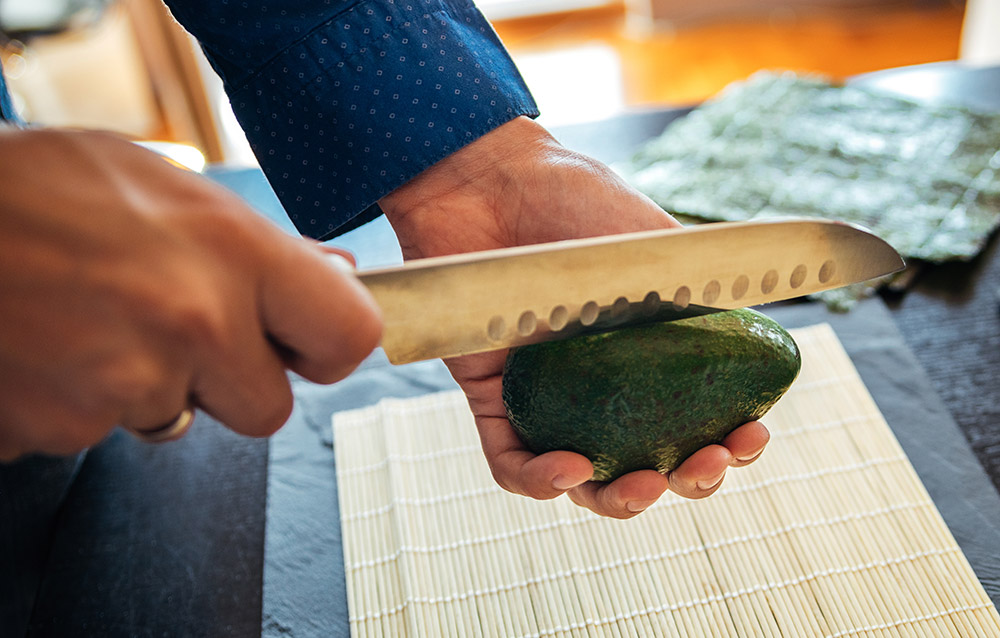
- Hold the narrower end of the avocado between the thumb and index finger of your guide hand, with the broader end in your palm.
- Cut into the skin of the avocado along its vertical center until the blade of your knife hits the seed.
- Use your guide hand to rotate the avocado into the blade, cutting into the skin and flesh. Make sure that you maintain constant contact between the blade and the seed.
- Continue using the rotating motion to cut around the avocado seed. You should have turned the avocado 360 degrees.
- Having set aside your knife, grasp a side of the avocado in each hand and twist them in opposite directions. This will loosen one of the avocado halves from the seed.
- Separate the halves and notice that the seed remains on one side while the other has a hollow where the seed used to be.
- Take the half with the seed in your guide hand. The skin side should be down, with the tapered end between your fingers and the wider end in your palm.
- Hold the knife so that its heel is about 3 inches (7.5 cm) away from the center of the seed.
- Make a light chopping motion into the seed, moving from the wrist. You should aim to bury the blade ¼ to ½ inch (6 to 12 mm) in the seed.
- To loosen the seed, twist the embedded knife and the avocado in opposite directions.
- Use the knife to pull the seed out with it still attached. Avocado seeds are slippery, so wrap your hand with a dishcloth before pulling it off the knife.
Note: I do mean a light chopping motion. You want to embed the blade in the seed, but not cut all the way through it. In a worst-case scenario, making your chopping motion too hard could cut all the way through the avocado and into or through your fingers. To take out the guesswork, start by bringing the knife down lightly enough to bounce off the seed and then gradually increase your force until it is buried the right amount.
Peeling an Avocado
You will need to remove the avocado’s skin before eating it. There are several ways to do so, including using a spoon, and they all work well. Here’s my favorite method.
- With one half of the avocado in your guide hand, cut a nick in the skin’s edge at the top of the avocado. Slide the blade under the newly-cut flap of skin and pull it up slightly.
- Grasp the flap of skin between the blade and the thumb of your knife-hand. Peel the avocado skin away from the flesh by gently pulling it back.
- The skin won’t come off in one piece, so you will need to repeat steps 1 and 2 until you’ve peeled the whole avocado.
Using a Spoon to Peel an Avocado
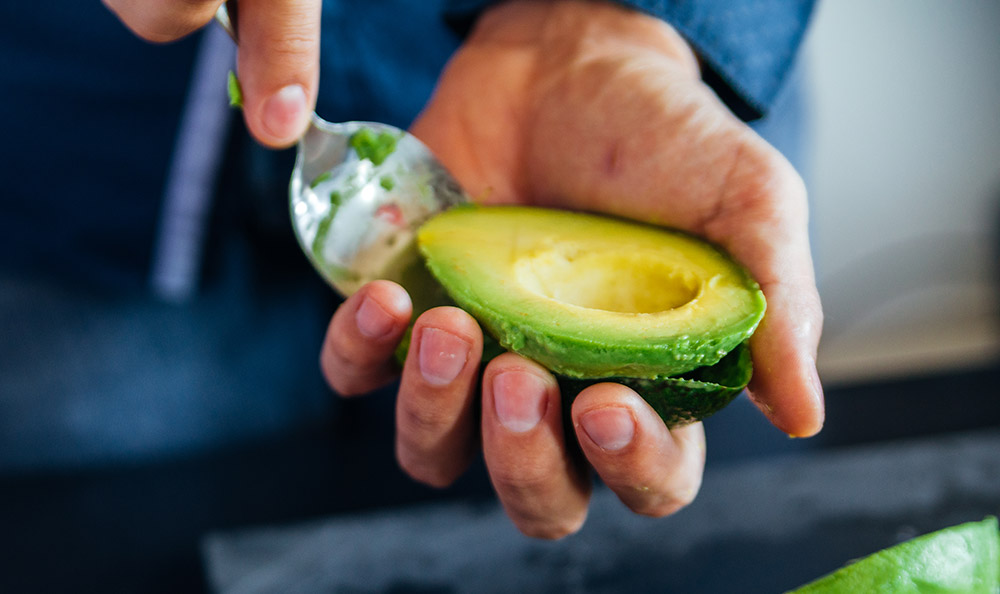
- Take an avocado half in your guide hand, with the tapered end between your thumb and fingers and the wider part in your palm. Slide the tip of the spoon between the skin and the flesh at the top of the avocado, and push it down.
- Rotate the spoon so that its handle is perpendicular to the avocado.
- Pull the spoon towards you, holding it at an angle so that its edge scrapes along the inside of the skin.
- Once your spoon reaches the bottom of the avocado, turn the avocado so that the wider end is now between your thumb and index finger, without removing the spoon.
- Repeat step 3 for this side of the avocado.
- It could take some practice before you are able to remove the avocado with no flesh left on the inside of the skin. If there is avocado flesh left, scrape it out with the spoon.
Cutting Slices (Fast Method)
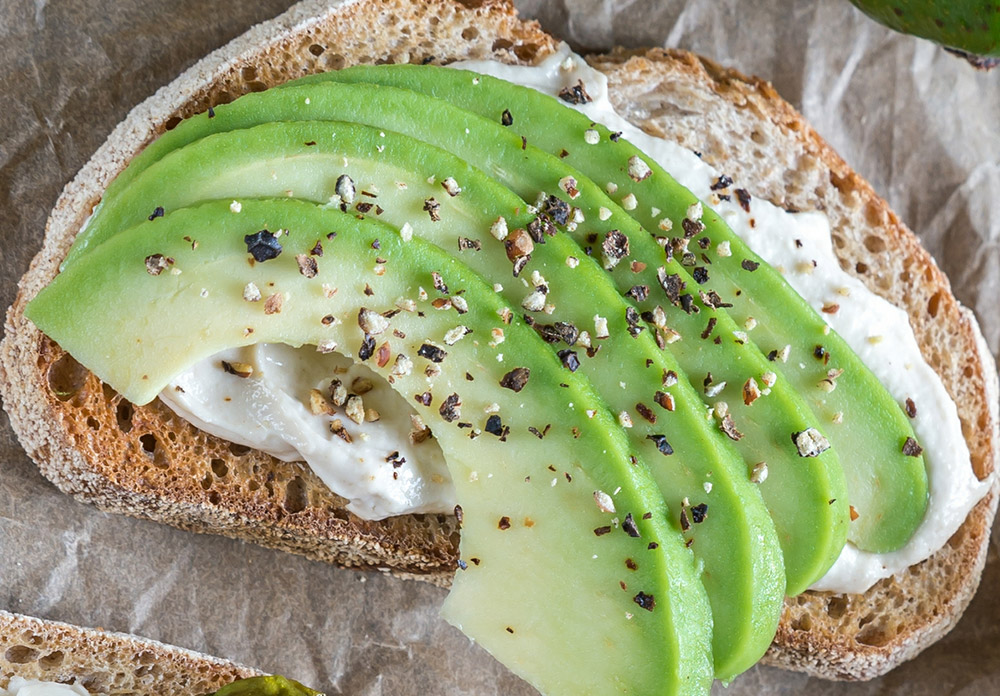
Avocado slices work well for things like salads and sandwiches. You can cut them diagonally, vertically, or horizontally—just consider what will be most functional and attractive for your dish.
This method is faster than the fan method, so choose it if you are short on time and don’t require perfect slices.
- Start with a peeled avocado half. Place it on the cutting board, cut side down, and use your guide hand in the claw position to steady it.
- To make your first slice, place the knife blade against your guide fingers, and cut down.
- With the blade still against your guide fingers, move them back slightly and cut down for another slice.
- Repeat step 3 until the entire avocado half has been cut into slices.
Cutting Slices (Fan Method)
This method is best for cutting perfectly even ¼ inch (6 mm) slices. I recommend using a Chef’s knife or Santoku.
- Begin by placing a peeled avocado half on the cutting board with the cut side down. Make sure that the wider end is facing you and that it is close to the edge of the cutting board. Use your guide hand to steady it.
Note: To get your avocado in the right spot, make sure that the knife handle is beyond the edge of the cutting board. Holding the handle directly above the board makes you prone to tilting the knife towards the tip, which means uneven slices.
- Set your blade ¼ inch (6 mm) in on the knife hand side of the avocado. Angle your blade so that it is slightly above parallel with the board. Cut through to where the centerline of the avocado rests on the board.
- Move the knife ¼ inch (6 mm) and slightly increase its angle. Again, cut through to where the centerline meets the board.
Note: Keep in mind that the knife blade should be vertical at the center of the avocado. Measuring how many slices you’ll make until that point will help you decide how much to increase the angle with each cut.
- Repeat step 3 until the center of the avocado, changing the angle slightly with each cut. Once you reach the center, cut straight down.
- Set aside the slices you have cut and set the unsliced half onto its newly-cut side.
- Repeat steps 2-4 until the second half is also in slices.
Note: You can use this technique on most round fruits and vegetables.
Dicing a Peeled Avocado
If the appearance of your avocado cubes is important to you, choose to dice the avocado after you have peeled it. This method provides a much more even result, but it is also a more delicate process. Again, I recommend a Chef’s knife or a Santoku for this task.
- Place your peeled avocado half on the board cut side down. Make sure it’s close to the edge of the board and that you are steadying it with your guide hand.
- Hold your knife parallel to the board at your desired height.
Note: As with the fan method, make sure that the knife handle is beyond the edge of the board to avoid uneven cuts due to tilting the knife toward the tip.
- Cut through the avocado horizontally. For smaller dice, make narrower cuts, and cut larger dice, make your cuts wider. Don’t unstack the avocado while cutting.
- Replace your knife to make a second horizontal cut above the first, and the same width. The size of the avocado and the dice will determine how many cuts you’ll need to make, typically varying from one to four.
- Once finished with the horizontal cuts, set your guide hand on the avocado in the claw position.
- With the blade flush against your guide fingers, cut down to form a set of avocado sticks. Ensure that the distance from the edge of the avocado to your knife is the same as the width of the horizontal slices.
- Without moving the knife away from your guide fingers, move them back and cut down to form another set of sticks.
- Repeat step 7 until the whole avocado has been cut into sticks.
- Carefully slide your blade under the stack of avocado sticks and rotate the avocado 90 degrees.
- With your guide hand in a claw position, place the knife flush against the fingers. Making sure that the width is correct, and the avocado isn’t too far away from the edge of the board, cut down for your first set of dice.
- Move your guide fingers and blade back together to cut another set of dice.
- Repeat step 11 until all the sticks have been turned into dice.
Dicing an Unpeeled Avocado
This dicing method is much easier and faster than dicing an unpeeled avocado. However, you’ll have to be okay with less, even dice.
- Take an unpeeled avocado half in your guide hand, skin side down. Hold it so that the tapered end is next to your index finger, and the wider end is in your palm, and so that you can see the entire flesh clearly.
- Assuming the top of the avocado is in the 12 o’clock position, insert the tip of your knife at the 10 o’clock position.
- Cut gently through the flesh in a straight line down, letting the tip of the blade scrape the inside of the skin.
- Make evenly-spaced, parallel cuts across the avocado using this technique.
Note: Cut all the way down to the skin with each cut, but not through it.
- Turn the avocado 90 degrees and make a similar series of cuts perpendicular to the first cuts.
- The avocado should now be entirely cut in a grid pattern, with boxes that are all the same size.
- With the avocado in your guide hand, use a spoon to scoop out the dice. For more detailed instructions on scooping out the avocado, see the section “Using a Spoon to Peel an Avocado.”