Topic · Knife Skills & Vegetable Cuts
Vegetable Jardinière
What Is Vegetable Jardinière?
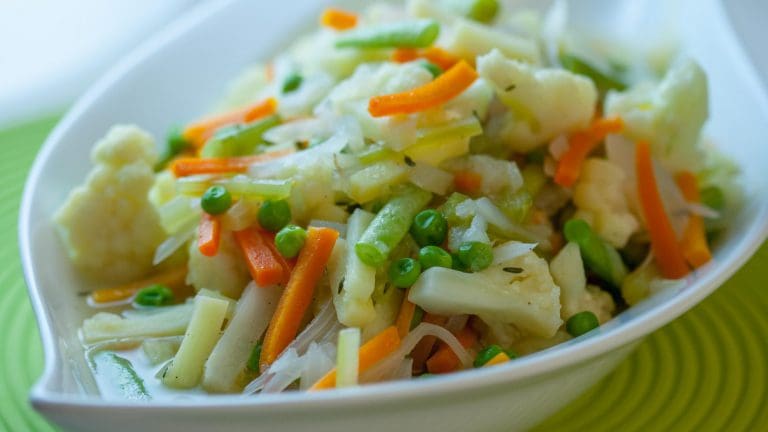
Vegetable jardinière is a French mixed-vegetable garnish traditionally served with roast meat, poultry and other main courses. The vegetables are selected to complement one another in flavour, colour and texture, then cut and cooked so they finish at a similar level of tenderness. The term jardinière also describes a classical baton cut: neat vegetable sticks approximately 3–4 cm long with a square cross-section around 4 mm.
Ingredients
- 113 g onion (¼ lb), quartered and finely sliced
- 227 g carrots (½ lb), peeled and cut into jardinière batons
- 227 g potatoes (½ lb), peeled and cut into matching batons
- 227 g turnip (½ lb), peeled and cut into matching batons
- 227 g celery (½ lb), trimmed and cut into similar lengths
- 227 g peas (½ lb), fresh or frozen
- 227 g green beans (½ lb), trimmed and cut to match the batons
- 113 g cauliflower (¼ lb), divided into medium florets
- 1 small bouquet garni
- 28 g butter (2 tablespoons)
- 12 g sugar (1 tablespoon)
- Approximately 710 mL water (3 cups), or enough to barely cover the vegetables
- Salt and freshly ground black pepper, to taste
How to Cut Jardinière Batons
Peel and trim the carrots and turnips. Cut them into even slices approximately 4 mm thick, then cut the slices into 3–4 cm lengths and finally into 4 mm square batons. Cut the potatoes and celery to a similar size. Consistent dimensions help the vegetables cook evenly and give the garnish a professional appearance.
Cooking Method
- Sweat the onion: Melt the butter in a wide casserole over moderate heat. Add the onion and cook gently until softened without browning.
- Start the firm vegetables: Add the carrots, turnips and celery. Add the water, bouquet garni, sugar, salt and pepper. Bring to a gentle simmer and cook for approximately 15 minutes.
- Add the potatoes: Add the potato batons and continue simmering for about 10 minutes, or until the vegetables are nearly tender.
- Finish the quick-cooking vegetables: Add the peas, green beans and cauliflower for the final 5 minutes. Adjust the timing as needed so each vegetable is tender but still holds its shape.
- Finish and serve: Check the seasoning, remove the bouquet garni and carefully drain most of the cooking liquid. Serve the vegetables hot as a garnish.
Jardinière Versus Macédoine
Jardinière is a baton-shaped cut, while macédoine is a small, even dice. In classical knife work, jardinière batons can be cut down into macédoine cubes. The names are also used for vegetable garnishes, so context matters: a menu may describe a mixed jardinière garnish, while a knife-skills lesson is referring to the cut itself.
Chef’s Tips
- Keep the batons as uniform as possible; uneven cuts produce uneven cooking.
- Add vegetables in stages according to their size and cooking time rather than putting everything into the casserole at once.
- Maintain a gentle simmer. Vigorous boiling can break the vegetables and make the garnish look ragged.
- Drain carefully and avoid overcooking. The vegetables should be tender while retaining their individual shape, colour and texture.
- Use the cooking liquid as a light vegetable base for another preparation if it has been handled and stored safely.
Key point: A successful vegetable jardinière combines a consistent cut, complementary vegetables and staged cooking so the finished garnish is colourful, evenly cooked and neatly presented.