
Topic · Knife Skills & Vegetable Cuts
Tourné Technique
Tourné knife for tourné cut
Tourné Knife also called Turning Knife is considered a type of utility knife that is used for many of the same tasks as the traditional paring knife. The bird’s beak knife, which is also known as a “Tournée” knife, has a two to a three-inch blade (shorter than that of a paring knife) and is designed to curve upward on both the cutting edge and the top edge.
This knife is commonly used to make a type of cut referred to as the Tournée cut in vegetables such as carrots, potatoes or squash, and is accomplished for purposes of food presentation. This cut is also known as tourné cutting or tournée cut. Bird’s beak knives may also be used to slice soft fruits such as nectarines, plums, or peaches and for peeling skins or blemishes from a variety of fruits and vegetables. It is a knife that is also used for cutting decorative garnishes such as rosettes in radishes or fluted mushrooms.
Tourné Cut
The tourné cut is a challenging one that requires a lot of practice to master and a lot of patience. The goal is to shape a piece of vegetable into a certain form. Depending on the vegetable, the number of faces will vary.
Most of the time, the end result is a vegetable piece with seven equal sides and blunt ends. This is true for potatoes and carrots; other vegetables, such as zucchini, are partially turned to achieve a better yield or for variety. The length will also vary, but the most common size is 5 centimeters (2 inches) long.
It is not as easy as it may sound, so don’t be discouraged the first time around. Keep on practicing. You will go through a lot of vegetables. I suggest you practice the motion with an egg before you try the technique with an actual vegetable.
Tourné is French for “turned”, and in this technique, the vegetable is turned after each cut.
Once cut, the vegetables will cook evenly and the presentation will be elegant on a plate. All you need is a sharp tourné knife.
Practicing the motion with an egg.
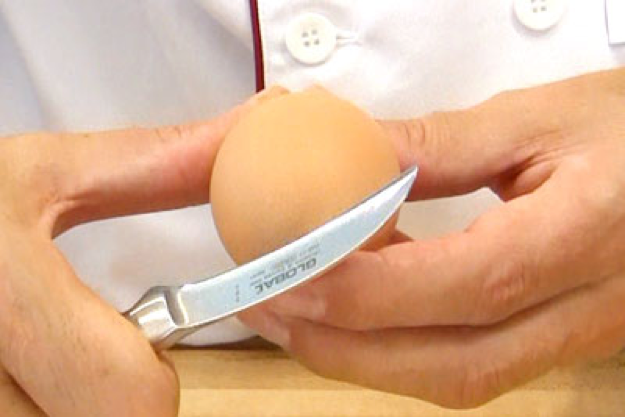
Hold the egg in your guide hand.
Place the thumb of your other hand at the bottom of the egg and place the knife blade near the top of the egg.
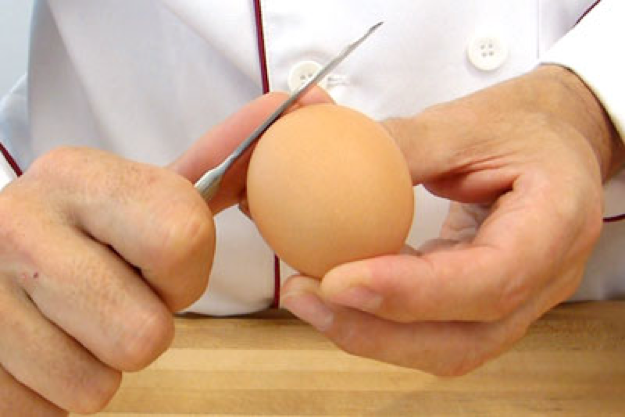
Drag the knife down to your thumb, following the curve of the egg.
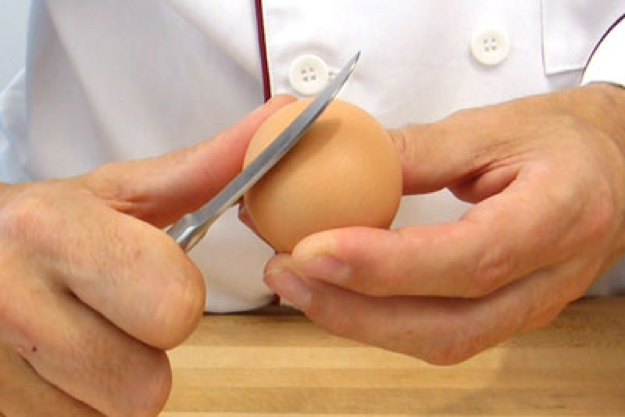
Rotate the egg, raise the knife back to the top and repeat the motion.