
Topic · Working in a Restaurant
Garde-Manger in Brigade
In professional kitchens, hors d’oeuvres and appetizers are prepared by the Garde Manger.
The “garde-manger,” “keeper of the food” or pantry supervisor, is in charge of preparing and presenting cold foods, such as salads, hors d’œuvres, cold soups, aspics, and charcuterie. In smaller establishments, the garde-manger is an entry-level, general assistant position.
However, in larger restaurants and hotels, the garde-manger may perform additional food presentation-related tasks and even play a role in menu development. Edible centerpieces made from materials such as ice, cheese, butter, salt dough or tallow are one example of a specialty garde-manger task.
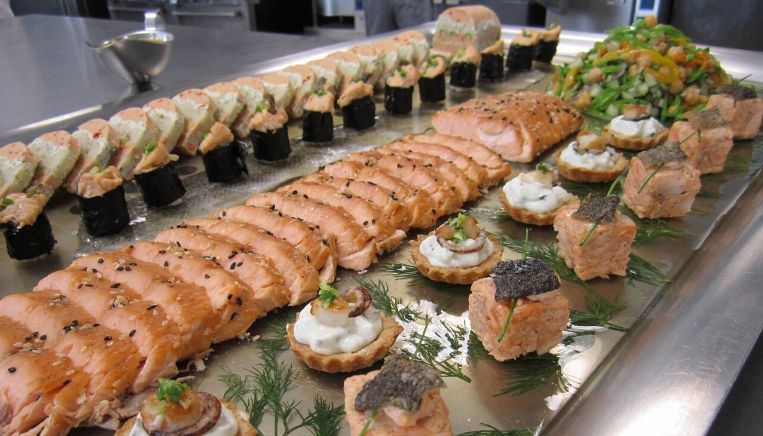
Salmon platter from a garde manger station
History
The term “garde manger” originated in pre-Revolutionary France, when one of the trappings of high social status was being able to show off an ample supply of food and being able to employ a talented staff to elegantly prepare and serve it. Noble families had a household steward, or “officier de bouche,” who would manage their cold storeroom. As refrigerators wouldn’t be invented for several hundred years, the officier de bouche was in charge of ensuring the preservation of the family’s surplus of butchered, pickled, salted, cured, and smoked foodstuff.
The food storage areas in these castles and manor houses were usually located in the lower levels since the cool basement-like environment was ideal for food storage and preservation. Over time, the term “garde manger” replaced “officier de bouche,” which more literally describes someone in charged with caring for food.
Individuals involved in the food industry outside noble homes typically sought guild membership to obtain professional support and stay abreast of the most current techniques in their field. For example, “charcuterie” was the name of a guild that prepared and sold cooked items made from pigs. Through this organization, the traditional preparation of hams, bacon, sausages, pates, and terrines were preserved, and new methods were developed and propagated. However, during the French Revolution, guilds were abolished, leaving garde mangers to take on the responsibility for tasks that had formerly been performed by charcuteries.
The position of “butcher” first developed as a specialty within the garde manger kitchen. As both the cost of and demand for animal proteins (in the form of pork, beef, etc.) increased, more space was required for their fabrication and portioning. This increased need for space was due not only to an upswing in the volume of protein sales, but also to the need for separating raw proteins from processed foods to avoid cross-contamination and the resulting possibility of food borne illness. As a result, special “butcher shops” were created where portion sizes, product utilization, and temperature could be tightly controlled. Today butcher shops exist both as standalone establishments and alongside kitchens in large hotels, country clubs and high volume restaurants.
Modern Garde Manger
The modern garde manger can denote an entry-level cook position within a restaurant, as it often involves preparing salads or other smaller plates which can be heated and quickly plated without significant experience. Nonetheless, in higher-profile, classically influenced restaurants and hotels, the position is in charge of the classical preparations and table settings.