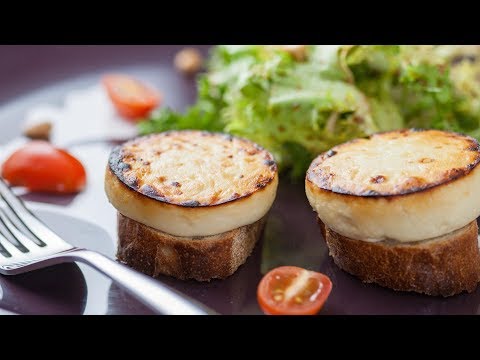
Prepare a warm goat cheese salad inspired by French bistros and the Berry region. Learn how to warm and serve goat crottin with crisp greens, a balanced vinaigrette and toasted bread.
Place each half on a lightly buttered slice of bread. Place the cheeses in the oven for 10 minutes then under the grill for 5 minutes. Keep an eye on it while cooking as it can go very fast and you do not want to burn your cheeses.
During this time, prepare the (dressing) by vigorously emulsifying the mustard, oil, vinegar, salt, and pepper. In a large bowl, toss the salad with the dressing. Serve in individual plates. Take the cheeses out of the oven and grind some black pepper on top. Place the slices of bread on the top of the salad. Serve while the cheese is warm and enjoy.
You can decorate the plates with some fresh walnuts and cherry tomatoes.
Warm goat cheese salad is a classic French bistro-style starter, associated with the Berry region and often made with a small goat cheese such as crottin de Chavignol. The cheese is warmed until soft and creamy, then served with crisp salad leaves and a bright vinaigrette. Toasted bread may be used as a base for the cheese.
Crottin de Chavignol is a traditional choice, but a similar soft or semi-aged goat cheese can be substituted when it is unavailable. Select a cheese that softens when heated but still holds its shape. Adjust the warming time to the size and maturity of the cheese.
Wash and dry the salad leaves thoroughly. Prepare a balanced vinaigrette with enough acidity to cut through the richness of the cheese. Dress the leaves lightly just before service so they remain crisp and do not collapse.
Warm the goat cheese using the method specified in the recipe, often on toasted bread or another suitable base. Watch closely so the cheese softens without melting away or scorching. Place it on the dressed salad and serve immediately.
Coordinate the timing of the warm cheese and cold salad. The contrast between warm, creamy goat cheese and crisp, lightly dressed leaves is central to the dish.
This recipe connects to Cook-Along: Salads & Side Dishes — learn the technique step by step in the video lessons.
The crottin de Chavignol is produced from the raw milk of an alpine race of goats that is exclusively farmed in the appellation area. If you'd like to go deeper, Cook-Along: Salads & Side Dishes covers this in full.
If you'd ever like hands-on guidance for your own kitchen or restaurant, I also offer 1-on-1 coaching through OCS, or you can reach me directly for consulting at 911ChefEric.com.
Recipes come out right when you understand the method. Chef Eric’s courses teach the foundations step by step — knife skills, stocks, soups and classic French technique — with video lessons and short quizzes. Not sure where to start? OCRS™ will build your roadmap in five questions.