
Topic · Appetizers Mastery
History of the French Appetizers
16th Century
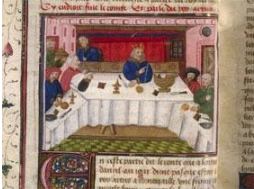
In 1555, the word “entrée” was first coined in France to describe smaller portions of food. After that, formal banquets regardless of the total number of course served began with a course called entrée de table (“entering to/of the table”). They ended with another called issue de table (“exiting the table”).
More detail regarding French course order, as well as specific menu samples, from this time, can be found in the book “Arranging the Meal: A History of Table Service in France” by Jean-Louis Flandrin.
During this period, dining rules were structured as follows: the entrée was the first course (with multiple entrées being acceptable), a bowl of soup was served directly after that, one or more roasts came next, and then a final course was served.
17th Century
Over the next hundred years, this sequence had changed little, with the notable exception being that by 1650, the soup was the first course, followed by the entrée.
According to the acclaimed 1651 cookbook Le Cuisinier François, an entrée was defined as a hot meat dish. The subsequent roast course consisted of fowl or rabbit cooked on a spit. At the same time, the entree was a more complicated, multi-component dish consisting of meat cooked in a specialty sauce, often with seasonal garnishes and other unique accompaniments.
The cookbook, as mentioned above, recently translated as “The French Cook,” provides entrée examples such as Ducks in Ragout, Sausages of Partridge White-Meat, a Daube of a Leg of Mutton, and Fricasée Chicken. At the time, an entrée was never served cold, nor did it consist of vegetables or eggs; the latter were known as entremets.
18th Century
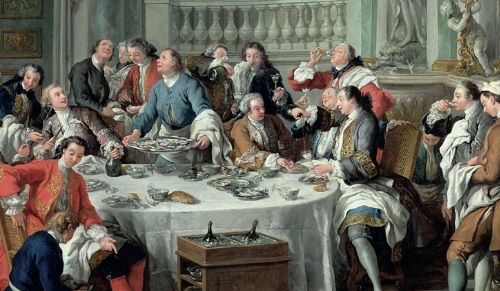
By the 18th century, the French, English (and colonial American) banquet meal was referred to as à la Française, or à l’Anglaise.
Meals were often served with two courses, each course consisting of an entire table-full of food. All the dishes were laid out on the table, with the essential dishes in the middle. The soup or fish could be presented at the head of the table, various entrees set in the middle sections, and the smallest courses (known later as the hors d ‘oeuvres) placed around the edges.
After the soup was eaten, it was removed and replaced on the table by another dish called the relevé in French or the remove in English. A remove typically consisted of a smallish portion of meat, such as a piece of fish, a joint, or a dish of veal. While the remove was being eaten, the other dishes (the entrees and entremets) stayed on the table. After finishing the first course, the dishes would be cleared away, and a second course would arrive. This second course revolved around the roast, usually hares or various fowl such as turkey, partridge, or chicken.
In the 19th century, course order changed significantly to a method known as service à la Russe. This method, which persists to this day, allowed plates to be served one course at a time, which kept dishes both fresh and warm as opposed to the Thanksgiving dinner style of past generations. Since the table was no longer covered with food, space was now available for table decorations and other adornments. This multi-course meal served in stages also gave rise to the invention of the menu, since diners now needed a list of options from which to choose their courses instead of selecting based on a pile of food served all at once as in the past.
19th Century
While “service à la Russe” became the norm in early 19th century France, in England and the U.S., the trend was popularized between 1850 and 1890.
The old-fashioned method of putting all the food on the table and having the host carve the roast, “service à la française,” persists on limited occasions, such as during Thanksgiving and Christmas dinners in the U.S. and Canada.
From about 1850 to 1950, a meal order generally followed the course order listed below:
- soup
- fish (possibly followed by a remove)
- entrée
- break (sorbet or rum or absinthe)
- roast
- possible other courses (salads, etc.)
- dessert
20th Century
By the 1930s, the word entrée was in transition. While some U.S. menus from this period used the word to refer to a recipe-based meat dish distinct from the roast, in others, the term denoted fish. Eventually, its classical placement in the course order was forgotten.
By the 1950sthe word, entrée became synonymous with roasts and fish and recipe-based meat dishes, leaving it to generally mean “the main course.”
Thus, the result is the typical three-course meal that we see today, consisting of an appetizer, entrée, and dessert. However, since the French use of the word entrée in Escoffier’s 1921 Le Guide Culinaire was still the traditional one, the change from the classic usage of a central heavy meat dish to the modern French usage of a light first course must have come after 1921. While the exact date of the change is unclear, the meaning of entrée must have changed by 1962 because, at this time, another culinary icon, Julia Child, was showcasing entrée recipes that consisted of light dishes, mainly quiches, soufflés, and quenelles.
In Summary
The word entrée has evolved quite a bit from its origins in 1555 as a “made” meat dish served as the opening course of a meal to a third-course selection to the American interpretation of the entree as the single main course. In French, the word changed its meaning by the 1930s to denote a light course of eggs or seafood, essentially taking on much of the meaning of earlier terms like hors d ‘oeuvres or entremets. No matter the culture, while the entrée has come a long way, it still retains some vestiges of its original function and, when appropriately prepared, continues to delight diners around the world.