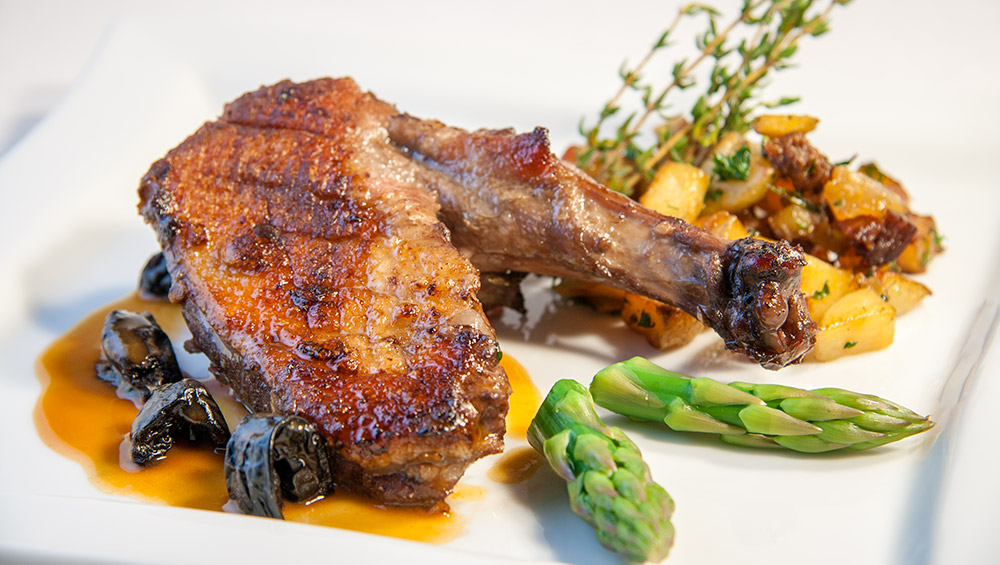
Succulent pan-roasted duck breasts served with a complex prune port sauce embellished with aromatic thyme and bay leaf.
In a saucepan, combine the sugar with 100 ml of water. Caramelize the sugar on medium heat. While heating, clean the sides of the saucepan with a brush and a bit of water to dissolve any excess sugar.
When the caramel is golden brown, remove from heat. Add the Port wine and flame carefully. Reduce by 70% on very low heat. Add the red wine, thyme, bay leaf, quartered prunes, and reduce again by 70%.
Add the ½ glace and continue reducing on very low heat. Season to taste. Skim the surface regularly to remove any foam or grease. The sauce is the right when it coats the back of a spoon nicely.
Strain through a sieve and discard the thyme and bay leaf. Bring to a in a clean saucepan.
to taste. Immediately before serving, bring mixture to a boil, skim if necessary, and remove from the heat and Monter au Beurre (add the butter in knobs and blend using a whisk).
Preheat the oven to 400 degrees F.
With a sharp knife the fat of the duck breasts in a crisscross pattern.
Season the duck with salt and pepper.
Warm a heavy-bottomed ovenproof skillet over medium heat.
Place the duck breasts, fat side down, in the skillet to off the fat, about 6 minutes. Reserve rendered duck fat. Turn the duck breasts over and sear for 1 minute.
Turn the fat side down again and place the skillet into the oven to for 7 to 9 minutes, until breasts are medium-rare.
Let the duck breasts rest for 5 minutes then thinly slice.
Serve with the sauce on hot plates.
This recipe connects to Stock Making Fundamentals — learn the technique step by step in the video lessons.
Render duck fat slowly over low heat before searing — that patience is what gives you crisp skin without burning it. If you'd like to go deeper, Stock Making Fundamentals covers this in full.
If you'd ever like hands-on guidance for your own kitchen or restaurant, I also offer 1-on-1 coaching through OCS, or you can reach me directly for consulting at 911ChefEric.com.
Recipes come out right when you understand the method. Chef Eric’s courses teach the foundations step by step — knife skills, stocks, soups and classic French technique — with video lessons and short quizzes. Not sure where to start? OCRS™ will build your roadmap in five questions.
