
Topic · Stock Making 101
Mirepoix
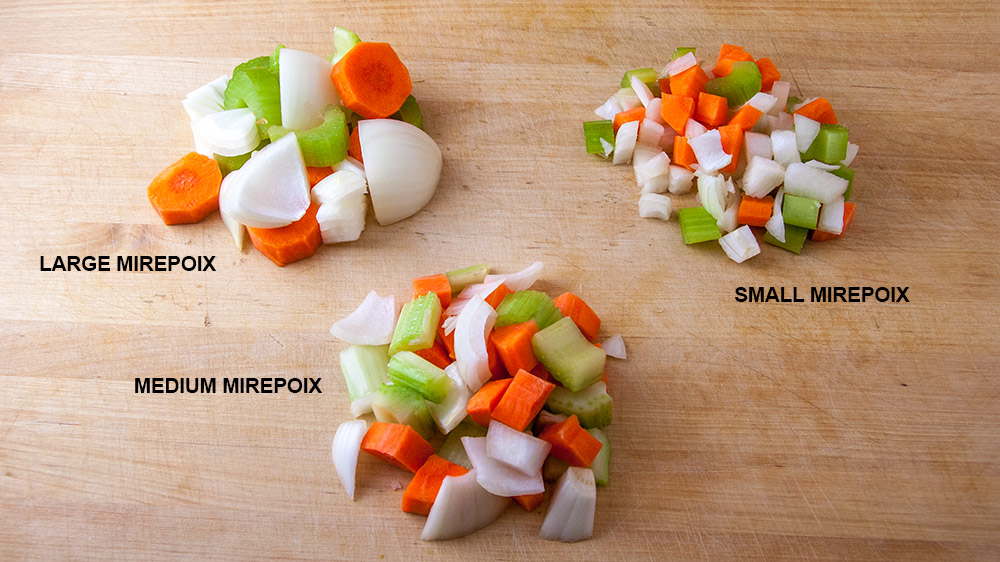
Mirepoix is the French name for a combination of vegetables. Mirepoix, either raw, roasted, or sautéed with butter is the flavor base for a wide number of dishes, such as stocks, soups, stews, and sauces.
Normally onion, celery, and carrot are used and these are cooked slowly in butter until they are very tender. Thyme and bay leaves are often added. These three ingredients are commonly referred to as “aromatics”. Similar such combinations, both in and out of the French culinary repertoire, may include leeks, parsnips, garlic, tomatoes, shallots, mushrooms, bell peppers, chilies, and ginger.
Traditionally, the basic ratio of ingredients is two parts onion, one part carrot, and one part celery, by weight. Because Mirepoix is not usually eaten, the vegetables, except the onions, do not have to be peeled. When making a white stock, or fond blanc, parsnips may be used instead of carrots to maintain the pale color. The size of the Mirepoix may vary according to the cooking time. The vegetables should be trimmed and cut into a size that will allow for good flavoring extraction.
- Fish fumet and Court Bouillons should have Mirepoix that has been cut small. (about ¼ inch)
- Stocks that will simmer for 2 hours may use a medium-cut Mirepoix (1/2 inch)
- Stocks that will simmer for over 2 hours may use a large-cut Mirepoix (1 inch)
- The size of the cut will depend on how the Mirepoix is to be used
Origin:
Mirepoix derives its name as many other elements of French cuisine, from the patron of the chef who established it. In this case, one of the houses of the Lévis, Seigneurs of Mirepoix, since the eleventh century and a famous name in Languedoc. The particular member of the house of Lévis whose chef is credited by the Dictionnaire de l’Académie Française with giving a name to an old technique is, Charles-Pierre-Gaston François de Lévis, Duc de Lévis-Mirepoix (1699-1757), Maréchal de France and Ambassador of Louis XV.