
Topic · Knife Skills and Safety Fundamentals
Honing vs. Sharpening
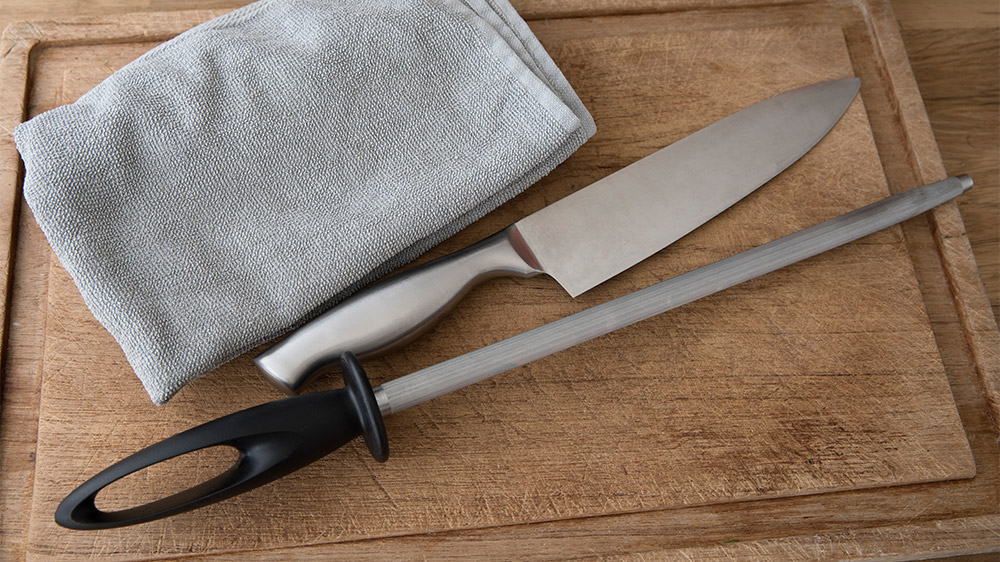
There will come a time when your knives do not cut anymore. They will become dull and if they are dull, they are dangerous to use. Indeed, a well-sharpened knife will give you control. It will properly respond to the pressure you decide to use. If you use a dull knife to cut through an apple, for example, you will use more pressure to go through the skin, and when the knife reaches the tender flesh, it will suddenly go through and that is a situation where you might cut and hurt yourself.
Therefore, it is very important to properly maintain your knives.
A sharp knife is a chef’s best friend, and therefore it is helpful if you know how to sharpen kitchen knives. To keep them really sharp, you will need to care for them on a regular basis.
Difference Between Honing and Sharpening
In general, one will use the term “sharpening” when talking about knife maintenance, but there are actually two different terms that you should be aware of. Although used interchangeably, the action on your knife will be different if you decide to hone or to sharpen it:
- Honing is maintaining the edge.
- Sharpening is repairing the edge.
The edge of a knife is made up of thousands of small teeth, called burrs. These teeth eventually get bent. Honing the knife realigns the burrs. After a certain number of usages, honing will not be sufficient anymore; you will then need to sharpen your knives.
Sharpening is a more radical process, as you are removing metal from your knife by grinding it away.
STEELING IS NOT ENOUGH TO SHARPEN A KNIFE. ACTUALLY IT ONLY REALIGNS THE MOLECULES ON THE SHARPENED EDGE. AFTER SHARPENING WITH THE STONE, USE THE STEEL FREQUENTLY TO KEEP THE BLADE IN GOOD CONDITION.